

By Charles Kim, Jennifer Chheda, Josh Nightingale, and Matt Johnson –
On November 10, 2026, USPTO Director John A. Squires and General Counsel John F. Duffy issued a memorandum titled “Returning Merits-Based Considerations to PTAB” (the “November memorandum”). Effective November 16, 2026, certain merits-based institution decisions for inter partes reviews (IPRs) and post-grant reviews (PGRs) will return to the Patent Trial and Appeal Board (PTAB), while non-merits review remains with the Director. The November memorandum also sets out merits-based “guidelines” and requires a different panel to conduct any resulting trial.
How the institution process has evolved
The USPTO has revised its institution process several times over the past 20 months. On March 26, 2025, it issued a memorandum titled “Interim Processes for PTAB Workload Management” that bifurcated institution decisions between (i) discretionary considerations and (ii) merits and other non-discretionary statutory considerations. Under that bifurcated process, the Director, in consultation with at least three PTAB judges, first determined whether discretionary denial was appropriate. If not, the petition was referred to a three-member PTAB panel to decide institution based on the merits and other non-discretionary statutory considerations. On October 17, 2025, the USPTO issued a memorandum titled “Director Institution of AIA Trial Proceedings,” (the “October memorandum”) which centralized institution decisions with the Director. The Director would consider discretionary, merits, and other non-discretionary issues and generally issue a summary notice granting or denying institution, with more detailed decisions or referrals to PTAB members in specified circumstances.1
What changes on November 16
The November memorandum restores a division of responsibility. The Director will continue to review non-merits considerations and may deny institution through a written opinion or summary notice. Petitions that pass that review will be referred to a three-member PTAB panel, assigned under Standard Operating Procedure (SOP) 1 (Rev. 17), to decide whether to institute review based on merits-based considerations. The panel will briefly address the merits-based considerations it finds important, including whether the petitioner has met the applicable standard for at least one claim and one ground, but need not address every ground or argument. If review is instituted, a new panel that includes none of the institution-panel judges will conduct the trial. The Director retains the statutory power to grant or deny institution.2 The change applies to IPRs and PGRs in which a notice referring the proceeding for consideration of merits-based issues has not yet been entered. The processes for briefing discretionary considerations and for briefing merits and non-discretionary considerations remain unchanged.3
Merits-based guidelines
The November memorandum also clarifies terminology. The set of considerations that prior agency documents called “merits and non-discretionary considerations” includes both (i) the statutory bars on institution based on the merits of the petition (e.g., a PGR petition that fails to show at least one claim is “more likely than not” unpatentable must be denied) and (ii) “discretionary factors related to the merits of the entirety of the challenges raised in the petition.”4 Both categories will be delegated to the PTAB under the new process.5 The memorandum provides the following illustrative, non-exhaustive guidelines for the PTAB to apply when analyzing merits-based and non-discretionary considerations:
- For each prior-art ground, a petition must explain how the prior art discloses or renders obvious each limitation of each challenged claim and identify the particular portions of the prior art on which it relies. Merely pointing to an examiner’s findings is insufficient.6
- “If a petitioner fails to make the requisite showing for a substantial majority of the challenged claims, the PTAB will deny institution.”7 This guideline appears to raise the bar for petitioners. The memorandum cites decisions denying institution where the petitioner made the requisite showing for only a small minority of the challenged claims (e.g., two of fourteen challenged claims in CyberSecure IPS, LLC v. Network Integrity Sys., Inc., IPR2025-01441, Paper 18 (Director May 26, 2026), and two of twenty in Chevron Oronite Co. LLC v. Infineum USA L.P., IPR2018-00923, Paper 9 (Nov. 7, 2018) (informative)). The guideline therefore places greater emphasis on the strength of the petition as a whole, although the memorandum does not define “substantial majority” numerically.
- Institution will be denied if the patent owner’s preliminary response raises a reasonable argument, supported by reliable, credible evidence, that the petitioner fails to meet the institution standard for a substantial majority of the challenged claims.8
- The same result follows if the PTAB itself identifies such a reasonable argument, supported by reliable, credible evidence, concerning a substantial majority of the challenged claims.9
- When applying guidelines 2 to 4, if the arguments for and against unpatentability of a particular claim are both reasonably supported when considering all of the evidence, the PTAB will not treat the petitioner as having met the “reasonable likelihood” IPR standard or the “more likely than not” PGR standard for that claim.10 This is notable because the USPTO previously indicated that the reasonable likelihood standard “encompasses a 50/50 chance whereas the ‘more likely than not’ standard requires greater than a 50% chance of prevailing.”11 Under the new guideline, a tie does not satisfy the IPR institution standard for the particular claim at issue.
The memorandum also identifies other circumstances that may bear on institution, including a prior adjudication that claims of the challenged patent or a related patent are not invalid or not unpatentable.12 The practical implication is that petitioners should assess both the strength of each challenged claim and the petition’s overall claim coverage.
Discretionary denials in context
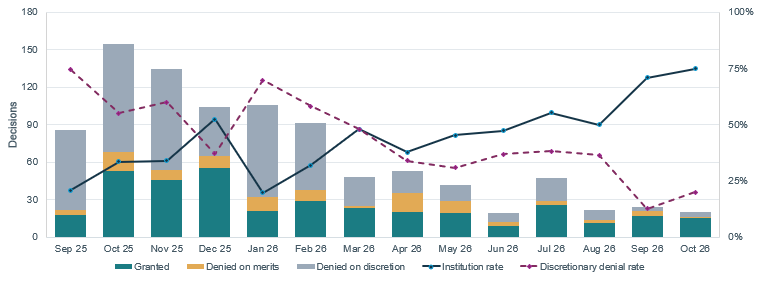
The November memorandum highlights the drop in the IPR discretionary denial rate, from about 60% of petitions in June 2025 to 15% in September 2026.13 The chart below shows a general downward trend in the IPR discretionary denial rate since the beginning of 2026, though the decline has not been uniform. The rate has remained below 40% since April 2026 and was 20% or less in September and October 2026. The IPR institution rate exceeded 70% in each of those two months. [Chart image: IPR discretionary denial rate — upload the attached PNG and insert here] Source: USPTO Open Data Portal and October 2026 institution notices. Later explanatory, review and remand rulings excluded.
Key takeaways
- The November memorandum returns the institution process to one resembling the bifurcated process announced in March 2025, with a few notable differences, including the new merits “guidelines” and assignment of a new panel of judges to conduct the trial if the PTAB institutes review.
- The new merits-based guidelines appear to demand a stronger showing from petitioners before the PTAB will institute review.
- For discretionary (non-merits) considerations:
- Magnolia Medical Technologies, Inc. v. Kurin, Inc., IPR2026-00097, Paper 17 (Director May 14, 2026) (precedential), remains the framework for the Director’s exercise of discretion. Parties should frame their discretionary denial briefing accordingly. Although not specifically mentioned in the November memorandum, other discretionary frameworks, such as Fintiv and General Plastic, remain relevant.
- For merits and non-discretionary considerations:
- Unlike the routine summary notices issued under the October 2025 process, the PTAB panel will issue a decision briefly addressing the important merits-based considerations.
- A tie favors the patent owner on the particular claim at issue under the memorandum’s equipoise guideline. Parties should assess the effect of those claim-level outcomes across the petition, without treating “substantial majority” as a defined numerical cutoff.
- The briefing processes remain unchanged, but the guidelines warrant strategic adjustments:
- Petitioners should present focused, well-supported challenges and assess whether adding weaker claim challenges could undermine the petition as a whole. Decisions about omitting claims should account for the broader litigation strategy, not simply whether a claim presents a close question.
- Patent owners should consider developing responses addressing dependent claims as well as independent claims. Where appropriate, an expert declaration at the preliminary-response stage may help show that the petitioner has not met the institution standard for particular claims, including where the evidence and arguments are in equipoise.
- Prepare for a fresh trial panel. If review is instituted, none of the institution-panel judges will sit on the trial panel.
Takeaway: Effective November 16, 2026, the Director will continue to handle non-merits considerations while referring surviving petitions to a three-member PTAB panel for merits-based institution decisions. The new guidelines raise the practical bar for petitioners, including by treating equipoise as a failure to meet the institution standard for a given claim, and a separate panel will conduct any resulting trial.
1 October memorandum at 1–2. 2 November memorandum at 6–7, 11–12. 3 Id. at 6–8. 4 Id. at 6 n.1. 5 Id. at 7 n.1. 6 Id. at 8. 7 Id. 8 November memorandum at 9. 9 Id. 10 Id. 11 USPTO, Message from Chief Judge James Donald Smith, Board of Patent Appeals and Interferences, https://www.uspto.gov/patents/laws/america-invents-act-aia/message-chief-judge-james-donald-smith-board#heading-1 12 November memorandum at 11. 13 Id. at 3.

Matthew Johnson
Latest posts by Matthew Johnson (see all)
- USPTO Returns Merits-Based Institution Decisions to the PTAB - November 15, 2026
- Director Denies Institution for Inconsistent Claim Constructions - October 9, 2026
- Director Terminates IPRs for Sotera Violations and the District Court Strikes Invalidity Contentions - September 17, 2026