

By Adam Cook and John Evans –
On February 2, 2026, a split Federal Circuit panel affirmed summary judgment of no design-patent infringement issued by a Maine federal court. Range of Motion Prods., LLC v. Armaid Co. Inc., No. 2023-2427, 2026 WL 261890 (Fed. Cir. Feb. 2, 2026). The panel majority’s analysis was routine under the governing framework for assessing design-patent claim construction and infringement set forth in the Federal Circuit’s 2008 en banc decision in Egyptian Goddess v. Swisa. Chief Judge Moore, however, dissented and frankly called for revisiting Egyptian Goddess and overhauling the “ordinary observer” standard—a move that signals big changes may be coming for design-patent litigation, both in the district courts and the PTAB.
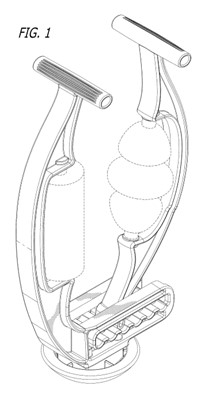
Here’s the setup. The plaintiff asserted that its design patent, U.S. Design Patent No. D802,155 (“’155 Patent”), claiming substantial parts of a massage device, was infringed by a rival’s device:
| Asserted ’155 Design | Accused Armaid2 Product |
 |
 |
The district court granted summary judgment of non-infringement, premised on a claim construction analysis that factored in the functional aspects of the claimed design. Design-patent infringement must be based on substantial ornamental similarity, which requires narrow construction of highly-functional elements, such as the arms of the claimed device design.
The panel majority affirmed, tracking the district court’s claim construction analysis. While the plaintiff urged that the functional aspects were still sufficiently ornamentally similar to create a fact issue on infringement, the panel majority disagreed. Id. at *5. Invoking the Gorham v. White Supreme Court standard from 1871, the panel majority held that the accused product was not sufficiently similar, on an ornamental basis, in light of the narrow construction driven by the functional aspects of the ’155 patent design, particularly in light of its base size and overall segmented appearance. Id. at *6.
Chief Judge Moore dissented, on the basis that the record showed sufficient similarity between the claimed and accused designs to warrant sending infringement to the jury for resolution. Although Chief Judge Moore did not take particular issue with the claim-construction analysis of functional aspects of the ’155 patent design, she focused instead on what she framed as “a small and easily solved problem in [the Federal Circuit’s] design patent law[.]” Id. at *7 (Moore, C.J., dissenting). In her view, the en banc Egyptian Goddess decision subtly shifted the frame of reference for design-patent infringement from the 150-plus-years-old “substantial similarity” standard in Gorham to the “sufficiently distinct” or “plainly dissimilar” language in Egyptian Goddess. Id. at *7–8 (Moore, C.J., dissenting). The former is framed in terms of overall similarities shared by the claimed and accused designs (which Chief Judge Moore viewed as the correct focus), while the latter is premised on differentiating the designs, which may cause minor differences to seem more important than they should be.
Chief Judge Moore believed that a reasonable jury could find that the claimed and accused designs at issue here were not substantially similar. But the summary judgment issue is whether no reasonable jury would find substantial similarity, and she felt that was a bridge too far. Id. at *9 (Moore, C.J., dissenting). Instead of playing a version of a childhood “spot the differences” game between the claimed and accused designs, Chief Judge Moore would invite judges to take a step back, look at the overall similarities instead, and leave the fact findings about differences in details to juries.
A pointed dissent by the Chief Judge signals that Egyptian Goddess could soon be revisited and revised, which would have a profound impact on design-patent claim construction and the “ordinary observer” analysis that governs infringement (in the district courts) and anticipation (in the PTAB). A broader and more flexible substantial similarity analysis would follow an overall trend in Federal Circuit jurisprudence that makes design-patent prior-art analysis more flexible, in line with recently relaxed obviousness standards that we covered in a prior blog post about LKQ v. GM. And, in theory, reframing Egyptian Goddess in the way Chief Judge Moore suggests would make it easier for patent challengers to show anticipation and would also make it easier for patent owners to survive summary judgment challenges in district court litigation.
Latest posts by John Evans, Ph.D. (see all)
- Chief Judge Signals Changes May Be Coming for the Ordinary Observer Test - March 12, 2026
- Show Me the Evidence: Primary References Still Required after LKQ - October 3, 2025
- Another Fender-Bender between LKQ and GM - July 31, 2025